
The complete guide
How To Choose A Convertible Gym Bag That Actually Fits Your Week
The bag problem nobody talks about
Most people own two bags too many. There is the gym bag that is the right size on a normal Tuesday and useless when you have a match or a trip. There is the weekend bag that lives at the back of a cupboard and comes out four times a year. And there is usually a tote or a backpack doing the overflow work in between.
The annoying part is that none of them are bad bags. They are just each built for one job. A convertible gym bag tries to cover the middle ground, and the better ones do it without feeling like a compromise. The point is simple. You should be able to grab the same bag whether you are heading to a lifting session after work or catching a Friday night flight.
How an expandable duffle works
The expansion idea is older than it looks. A zip runs around the body of the bag, usually near the base or along one side. Zipped closed, a panel of fabric is folded into itself and the bag holds its smaller shape. Unzip it and that folded panel opens out, adding depth and volume.
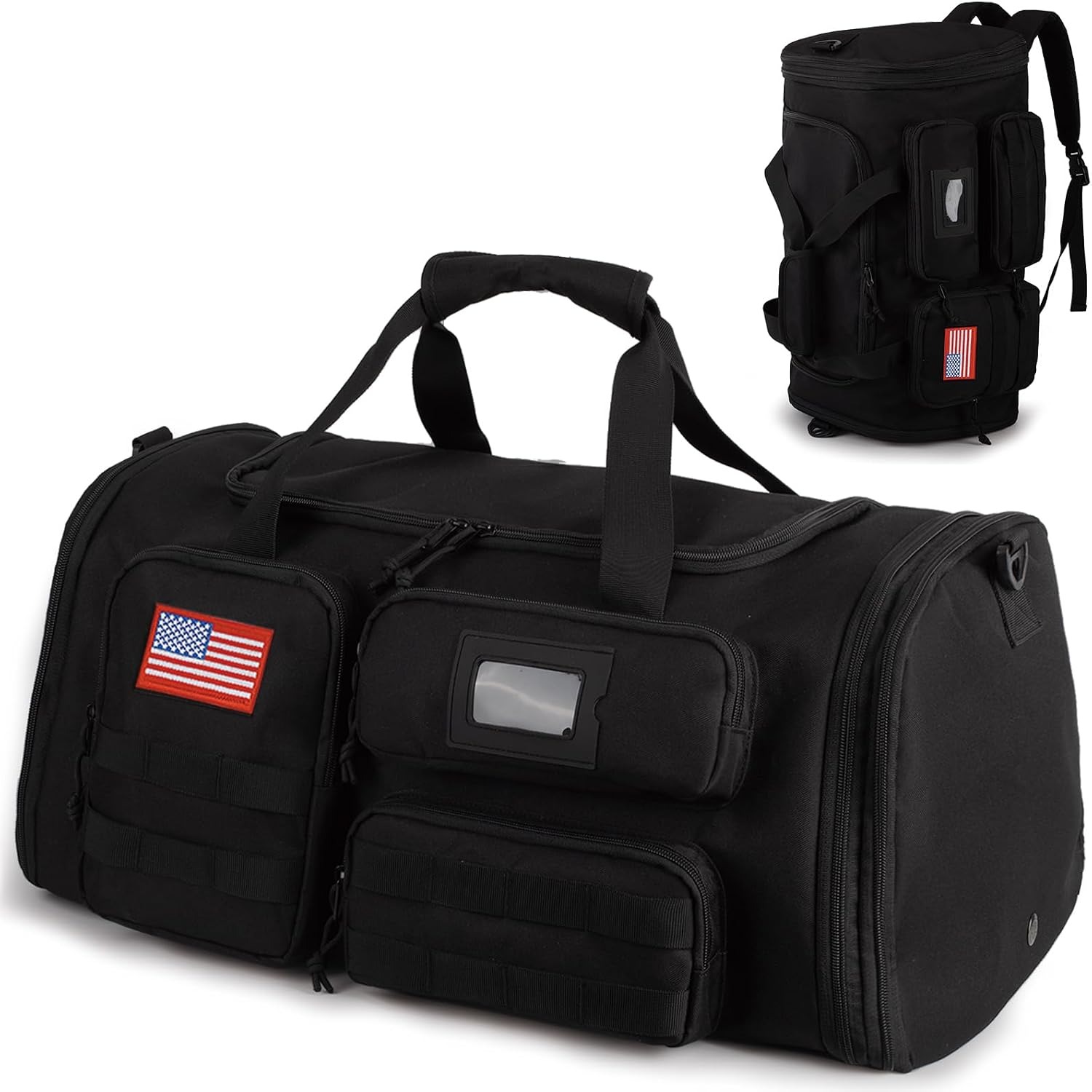
On this bag that takes it from 50 litres to 58 litres. Eight litres does not sound like much written down, but in packing terms it is roughly the difference between a change of clothes and a change of clothes plus a jacket, a pair of jeans and a wash bag. The important thing is that you are not carrying a part-empty 58 litre bag on days when you only need half of it. A bag that is too big is almost as awkward as one that is too small, because loose contents slide around and the bag loses its shape on your back.
There is one honest trade-off. Expansion panels add a zip, and zips are the part of any bag most likely to fail eventually. The fix is not complicated. Do not force a zip through a bulging bag, pull the slider straight rather than at an angle, and keep grit out of the teeth.
Duffle, backpack, or riding your suitcase
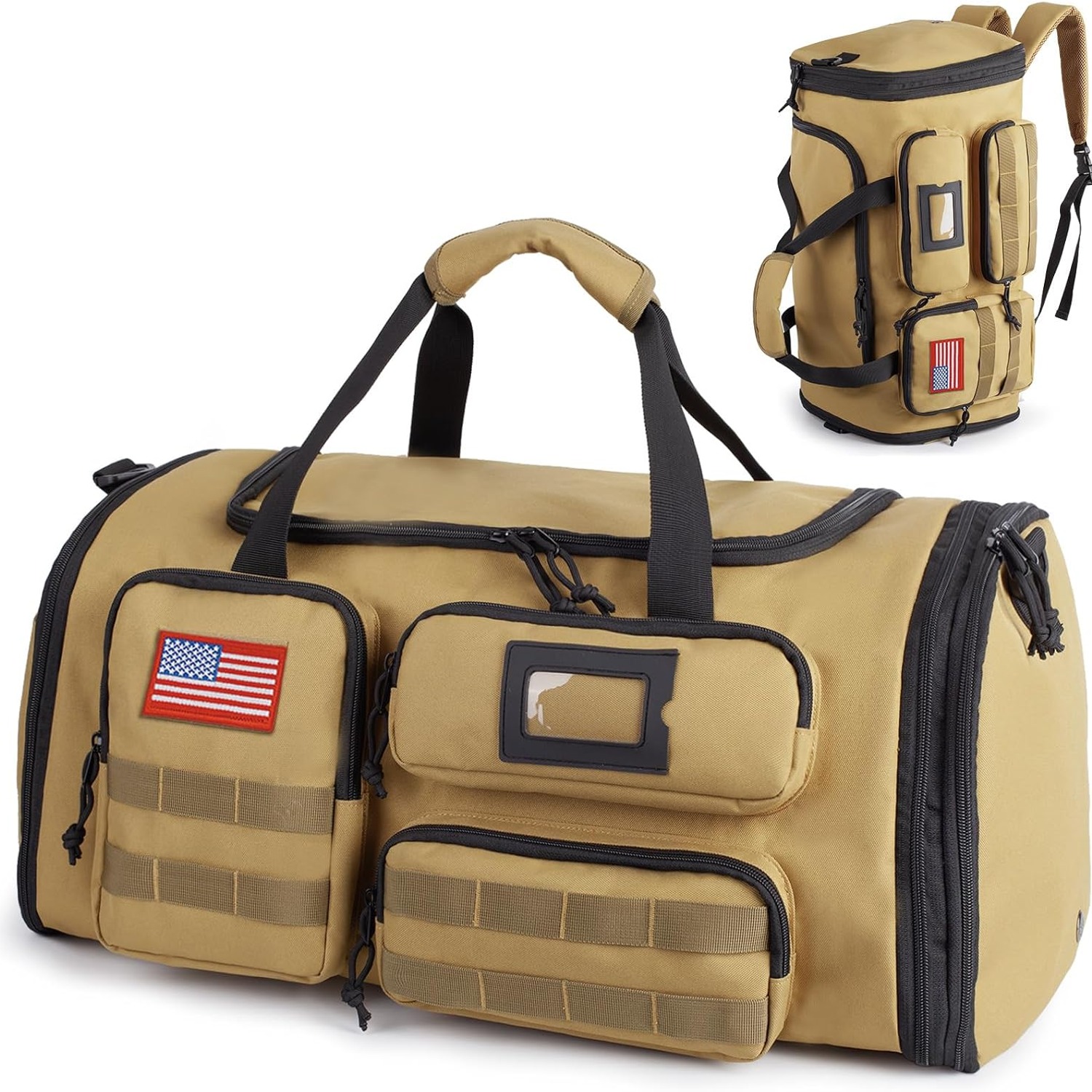
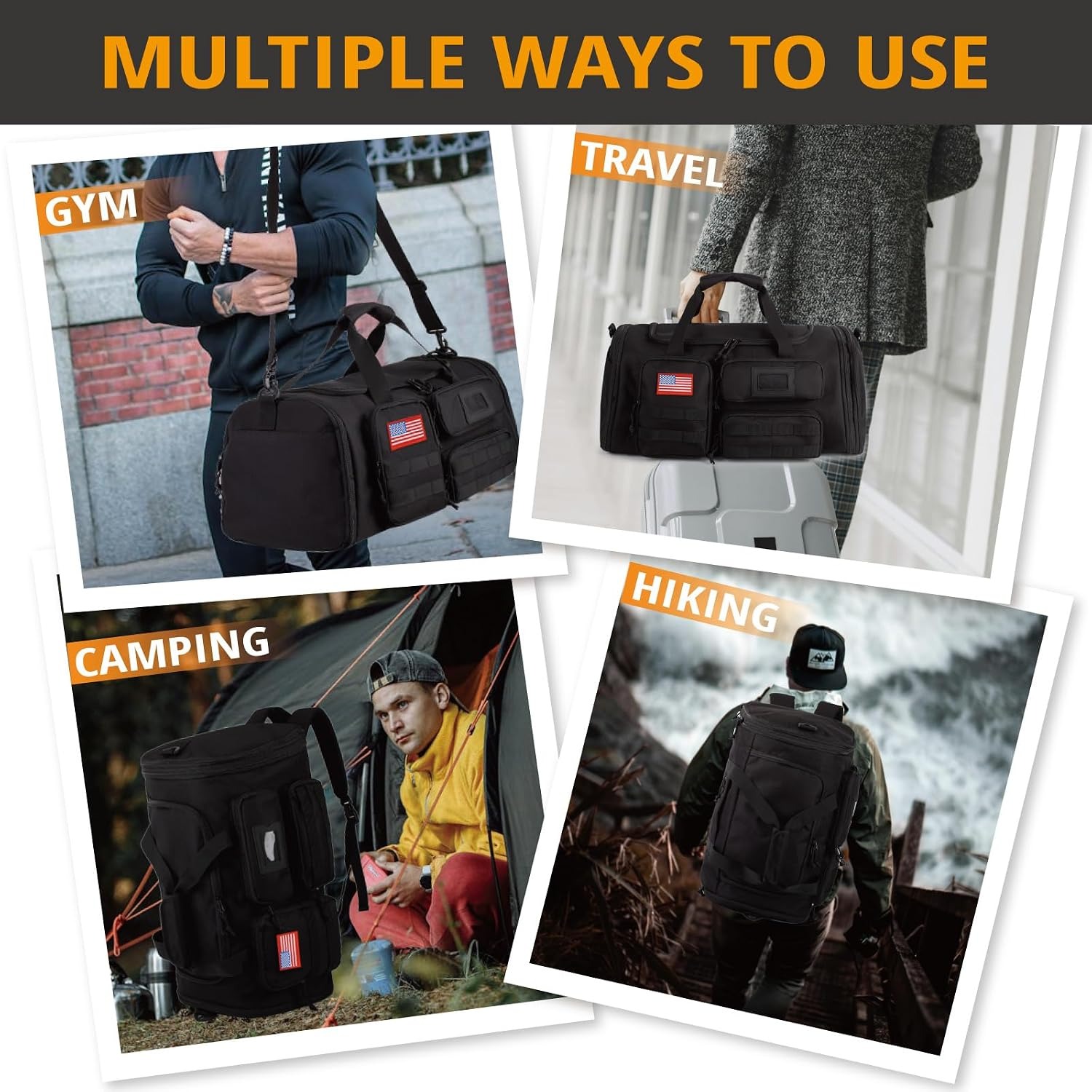
Three carry modes sounds like marketing until you use them in the same week.
Duffle mode, using the web handles, is the fastest. You grab it out of the car boot, walk fifty metres, drop it in a locker. No adjusting, no shrugging straps on.
Backpack mode earns its keep on the days you are not driving. Anyone who has carried a loaded duffle on one shoulder for twenty minutes knows how quickly it starts to hurt. Splitting the weight across both shoulders with adjustable straps makes a 10 kg load feel manageable, and it frees your hands for a bike, a ticket barrier or a coffee.
The third mode is the one people overlook. A strap sleeve on the back panel slides over a telescopic suitcase handle so the bag sits on top of your case. In an airport that is the difference between walking comfortably and constantly rebalancing a shoulder strap. If you travel with a roller case more than a couple of times a year, that sleeve pays for itself fast. It is a feature worth looking for in any duffle backpack for travel.
Why the shoe compartment matters more than you think
Shoes are the reason gym bags smell. Trainers come off warm and damp, go straight into the main compartment, and sit pressed against a clean shirt for the rest of the day. By the time you get home, everything in the bag has picked up the smell.
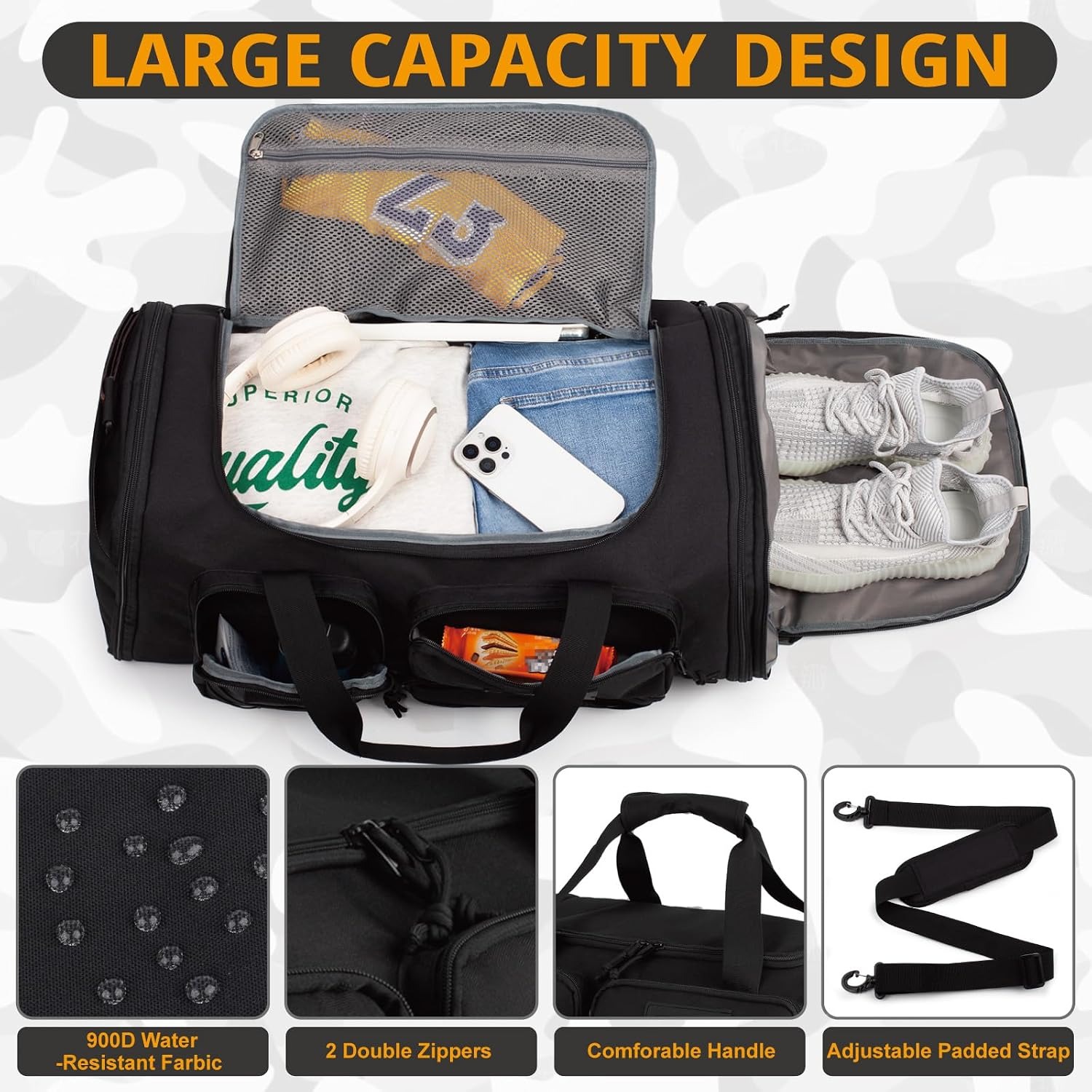
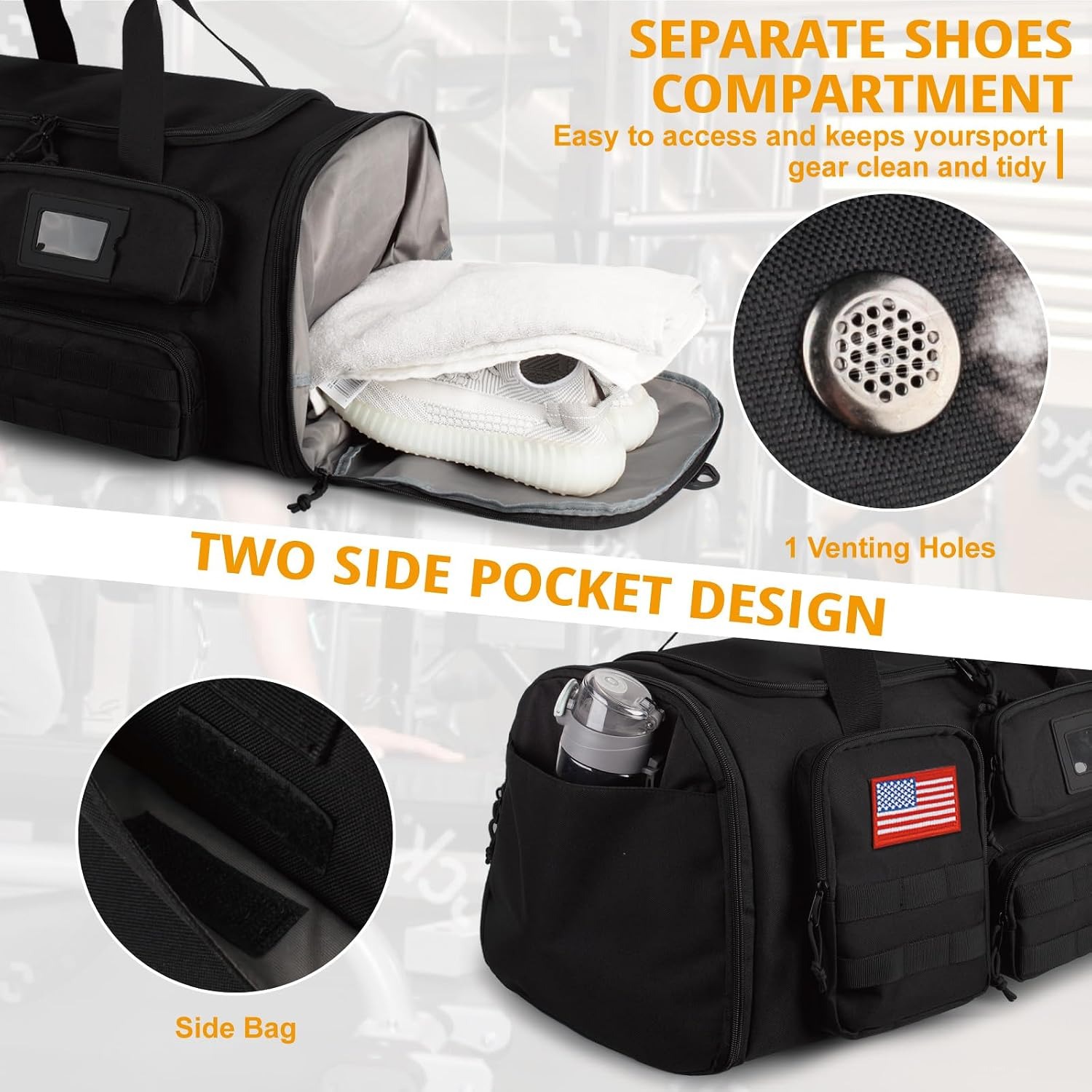
A separate shoe section with ventilation holes solves most of that. The shoes get their own space, air can move through, and the rest of your kit stays out of contact. It is the single feature that separates a decent gym bag with shoe compartment from a generic sports holdall.
Two practical tips. Empty the compartment the same day rather than leaving shoes in there overnight, and use the same space for a wet towel or a sweaty top when you are not carrying shoes. The ventilation works the same way for damp fabric.
Fabric, water and real-world wear
The shell here is 900D polyester with a water-repellent finish. The D number refers to the thickness of the yarn, and 900D sits in the heavier end of bag fabrics. It is the sort of weave used on tactical packs, chosen because it resists scuffing and abrasion rather than because it looks rugged.
Water repellent means a surface treatment makes water bead and roll off rather than soak in. It is not the same as waterproof. Walk ten minutes in drizzle and your contents stay dry. Leave the bag outside in a downpour and water will eventually find its way through the zips and stitching. If you regularly carry electronics, a cheap dry bag or pouch inside the main compartment covers that gap.
Over time the water-repellent coating wears off, especially where the bag rubs against your back or a car seat. Spot cleaning instead of machine washing slows that down a lot. Hot water and detergent strip the finish faster than anything else you could do to it.
How to work out if this size suits you
Forget the litre number for a moment and think about your actual week.
If your gym kit is shorts, a top, trainers, a towel and a bottle, almost any mid-size duffle covers it. The question is what else you carry. Add work clothes to change into, a packed lunch and a laptop sleeve, and the 50 litre closed size starts making sense rather than looking oversized.
For travel, the maker suggests two to five days for one person. That is a fair guide at 58 litres. Pack a pair of shoes, three or four outfits, a wash bag and a layer, and you are using most of the space. Two people sharing it for a weekend would be tight.
Then check the numbers against your airline if flying matters to you. The listed dimensions are 59.9 x 30 x 27.9 cm. Several carriers allow less than that for cabin baggage, so compare before you assume it goes overhead. Keeping the expansion panel zipped shut helps, since a soft bag that is not stuffed can usually be squeezed into a sizer.
Organisation without losing things
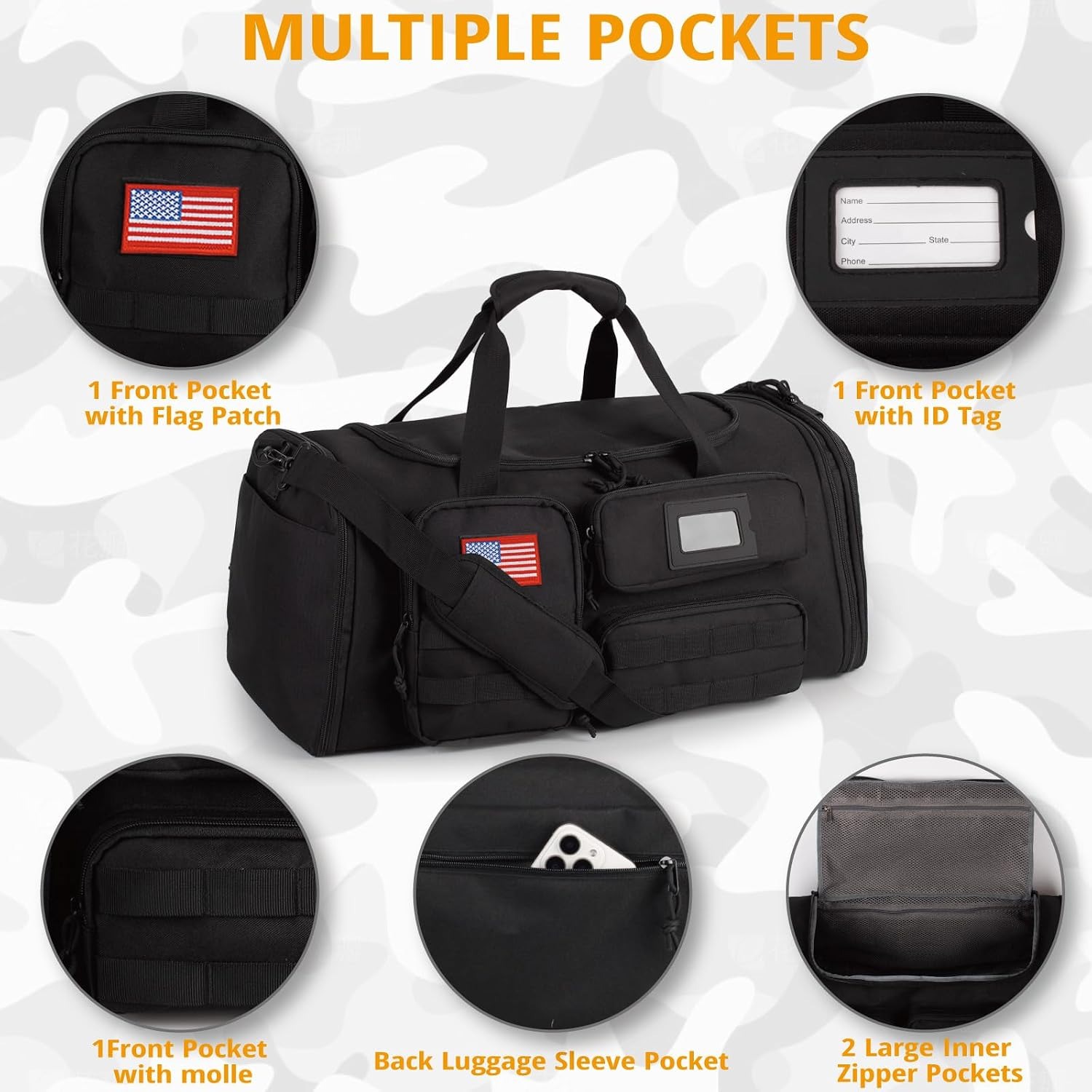
Pockets are only useful if you use them the same way every time. The layout here gives you a large front pocket, a smaller one with a card slot, a MOLLE panel for clipping things on, a rear zip pocket and two mesh zip pockets inside.
The habit worth building is assigning each pocket a job and sticking to it. Keys and card in the small front pocket. Headphones and a charger in the rear zip pocket, which is also the hardest for anyone to reach while you wear the bag. Toiletries in the large front pocket. Mesh pockets inside for anything that would otherwise sink to the bottom.
The MOLLE panel is optional extra capacity. Thread a carabiner through for a bottle, or add a small pouch if you carry something specific. If you do not need it, it sits flat and does nothing.
Looking after it
Care is mostly about not doing the wrong things. Wipe the outside with a damp cloth and mild soap. Air dry fully, out of direct sun. Do not machine wash, tumble dry, bleach or iron it.
Leave the zips open between uses so moisture does not get trapped, and store the bag somewhere dry rather than crushed under a heavier case. If the inside picks up a smell, empty it completely, open everything and give it a day in a well-ventilated room. That fixes most issues without any product at all.
The short version
A convertible gym bag earns its place when it replaces two or three bags rather than joining them in the cupboard. This one has the pieces that matter. It expands from 50 to 58 litres so it fits both a gym session and a short trip. It converts between duffle, backpack and suitcase-mounted carry. It keeps shoes separate and ventilated. The 900D polyester shell and water-repellent finish handle normal weather and normal abuse.
What it is not is a waterproof expedition bag or a padded laptop case. Pack accordingly, treat the zips with a bit of patience, and clean it by hand rather than by machine. Do that and it should cover most of your week without you thinking about it much at all.